
StraighterTeeth, Discreetly AlignedtoYourLife
Clear aligner treatment planned with iTero digital scanning and ClinCheck 3D preview — so you see your projected outcome before committing to a single tray.
Orthodontic outcomes depend on individual factors including compliance, oral health, and case complexity. Suitability is assessed at your consultation.
Straighter Teeth, Discreetly Aligned to Your Life
Clear aligner treatment planned with iTero digital scanning and ClinCheck 3D preview — so you see your projected outcome before committing to a single tray.
Orthodontic outcomes depend on individual factors including compliance, oral health, and case complexity. Suitability is assessed at your consultation.
Clear Aligners That Move Your Teeth in Sequence
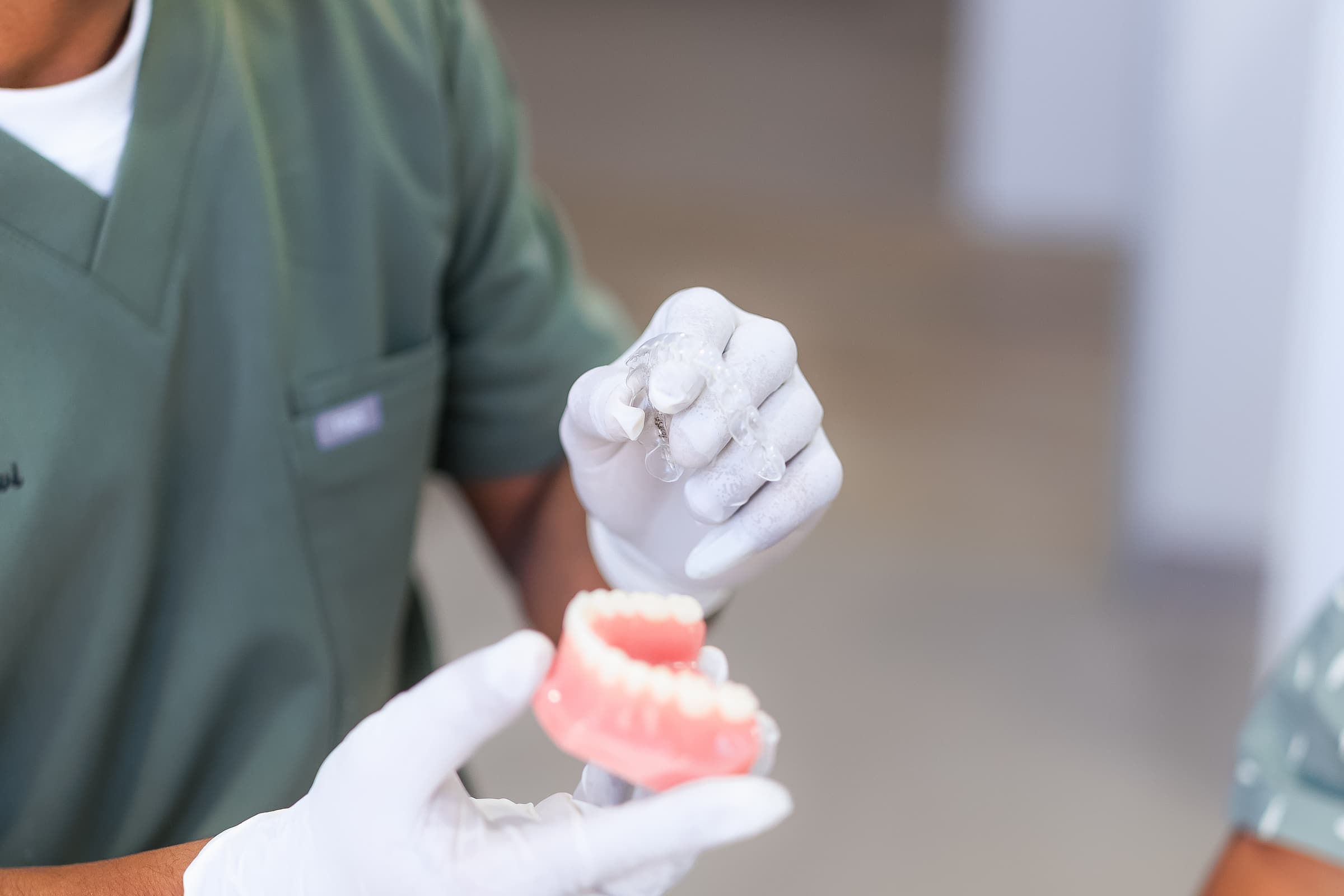
Invisalign uses a series of custom-fabricated clear aligners — each one slightly different from the last — to move your teeth incrementally toward the planned position. Since its introduction in 1997, Invisalign has treated over 17 million patients worldwide (Align Technology, 2024). The aligners are made from SmartTrack material, a medical-grade thermoplastic designed to apply consistent, controlled force across each stage of treatment.
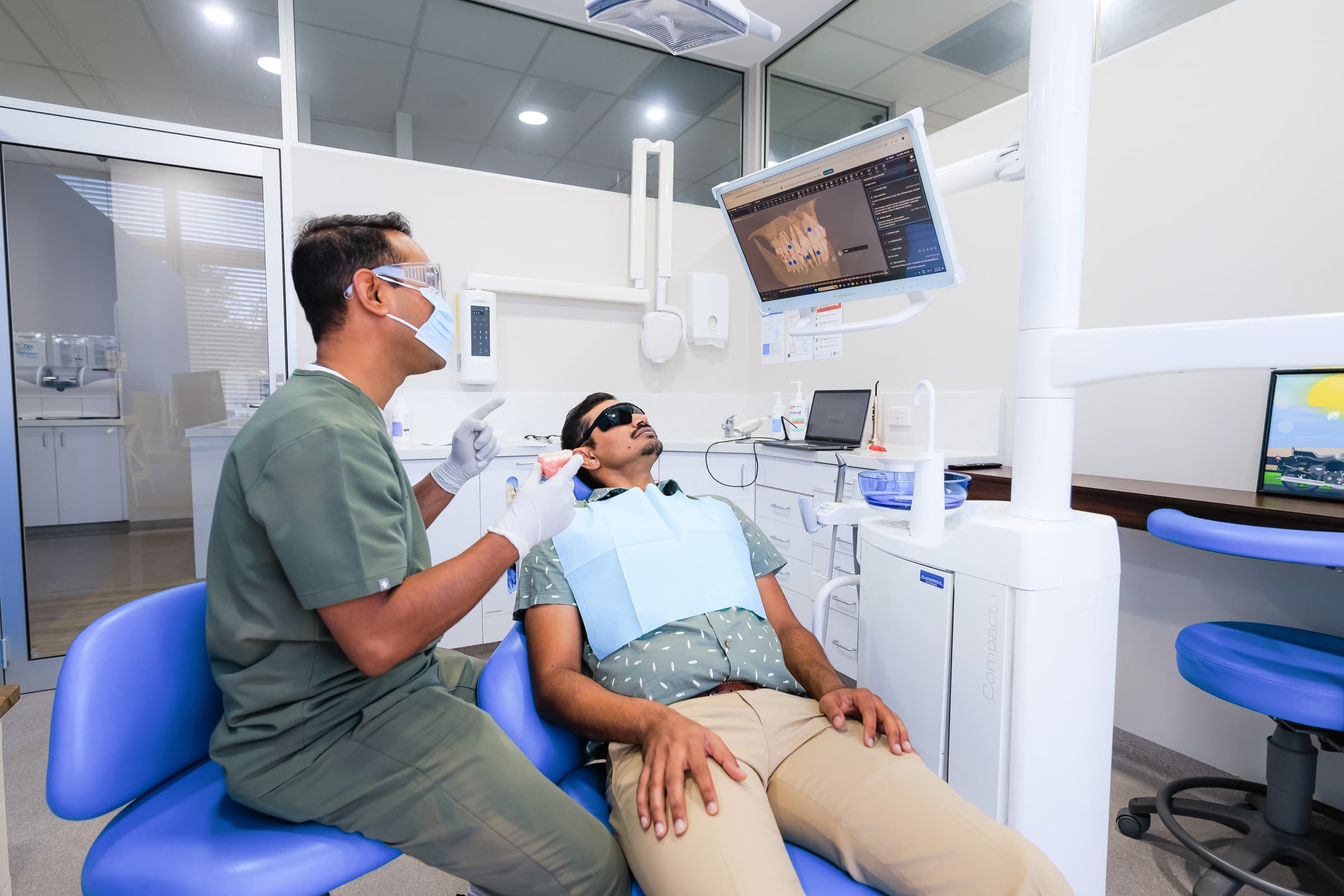
Each set of aligners is worn for one to two weeks before progressing to the next in the sequence. Treatment is mapped digitally using ClinCheck software, which produces a 3D simulation of your projected tooth movement from start to finish. You see the expected outcome at your consultation before committing to treatment.
Aligners are removable for eating, drinking, and oral hygiene — but must be worn 20 to 22 hours per day for treatment to progress on schedule. As one of the core treatments within cosmetic dentistry, Invisalign addresses both aesthetic alignment and functional bite concerns. A 2019 study in the Angle Orthodontist found that wear-time compliance is the single most significant predictor of treatment success with clear aligner therapy.
Content reviewed by Dr Abhishek Singh, AHPRA DEN0001639626.
Conditions Invisalign Can Address — and Limitations to Know
Invisalign is effective for a range of orthodontic concerns, but it is not suitable for every case. Suitability is assessed individually at your consultation.
Invisalign can treat
- CrowdingTeeth overlapping or rotated due to insufficient arch space.
- SpacingGaps between teeth caused by missing teeth, jaw discrepancy, or natural variation.
- OverbiteUpper front teeth overlapping lower front teeth vertically beyond the normal range.
- UnderbiteLower front teeth sitting in front of the upper teeth when the jaw is closed.
- CrossbiteOne or more upper teeth sitting inside the lower teeth rather than outside.
- Open biteUpper and lower front teeth not meeting when the back teeth are closed together.
Invisalign may not be suitable for
- Severe skeletal discrepanciesJaw misalignment requiring surgical intervention is beyond the scope of aligner treatment.
- Significant rotations of premolars or molarsLarge rotations of back teeth often require fixed brackets for adequate control.
- Severe crowding requiring extractionComplex extraction cases with significant space closure may require traditional braces.
- Vertical tooth movement (intrusion/extrusion)Aligners have limited ability to push teeth into or pull teeth out of the bone.
Suitability is assessed individually. Invisalign® is a registered medical device (ARTG). Content reviewed by Dr Singh, AHPRA DEN0001639626.
Your Invisalign consultation is complimentary
An iTero digital scan, a ClinCheck 3D treatment preview presented on-screen, and a written cost outline — before you commit to anything. No impressions. No obligation to proceed.
Your Invisalign Treatment, Step by Step
Invisalign treatment is not a single appointment. The process typically spans six to eighteen months depending on your case. Here is what happens at every stage — with projected timeframes based on your individual treatment plan.
Complimentary Consultation and iTero Scan
45–60 minutesYour first visit includes an iTero digital scan — a 3D impression of your teeth captured without traditional moulds or impression trays. Clinical photographs are taken and your bite is assessed. Dr Singh reviews your concerns, discusses your goals, and determines whether Invisalign is suitable for your case. This consultation is complimentary.
ClinCheck 3D Treatment Plan
1–2 weeks after initial scanUsing Align Technology's ClinCheck software, Dr Singh maps the projected movement of each tooth from its current position to the target position. The 3D simulation is presented on-screen so you can see the projected outcome of treatment. You review the plan, ask questions, and provide feedback before it is finalised. A written cost outline is provided at this stage.
Aligner Fabrication
2–3 weeks fabricationOnce the ClinCheck plan is approved, your custom aligners are manufactured by Align Technology. Each aligner in the series is precision-cut from SmartTrack material based on your 3D treatment plan. Attachments — small tooth-coloured dots bonded to specific teeth — may be placed to assist controlled movement.
Aligner Fitting and Instructions
30–45 minutesYour first set of aligners is fitted and checked for comfort. If attachments are required, they are bonded at this appointment. You receive instructions on wear time (20 to 22 hours per day), aligner changes (every one to two weeks), and oral hygiene during treatment. Chewies are provided to help seat each new aligner.
Progress Reviews
15–20 minutes per reviewReview appointments are scheduled every six to eight weeks. Dr Singh checks that your teeth are tracking to the ClinCheck plan, assesses attachment integrity, and provides your next sets of aligners. If tracking issues are identified, refinement aligners may be ordered.
Refinements and Retainers
Refinements: 4–8 weeks. Retainer fitting: 30 minutes.At the end of your active aligner series, your teeth are assessed against the original ClinCheck plan. If minor adjustments are needed, refinement aligners are fabricated at no additional cost (included in Comprehensive and Teen tiers). Once the final position is achieved, custom retainers are fitted to maintain the result long-term.
Projected timelines are estimates based on typical cases. Individual treatment duration varies. Content reviewed by Dr Singh, AHPRA DEN0001639626.
Invisalign and Traditional Braces — Understanding the Difference
Both Invisalign and traditional braces achieve orthodontic correction. The right choice depends on the complexity of your case, your lifestyle, and your preferences. This comparison presents both options factually — so you can discuss them with your dentist from an informed position.
Visibility
Clear, virtually invisible aligners. Difficult to notice during normal conversation.
Metal or ceramic brackets bonded to teeth with visible archwires.
Removability
Removable for eating, drinking, brushing, and flossing. Must be worn 20–22 hours per day.
Fixed to teeth for the duration of treatment. Cannot be removed by the patient.
Comfort
Smooth plastic. Mild pressure when switching to a new aligner, typically settling within one to two days.
Brackets and wires may cause initial soreness and soft tissue irritation. Wax is available for comfort.
Dietary restrictions
No restrictions — aligners are removed for meals. Avoid eating or drinking anything other than water with aligners in.
Hard, sticky, and crunchy foods must be avoided to prevent bracket damage.
Oral hygiene
Brush and floss normally with aligners removed. Clean aligners daily.
Requires specialised brushing techniques, interdental brushes, and floss threaders around brackets and wires.
Projected treatment duration
Typically 6–18 months for most cases. Express cases may complete in 3–6 months.
Typically 12–24 months. Complex cases may take longer.
Review frequency
Every 6–8 weeks. Fewer in-practice appointments overall.
Every 4–6 weeks for wire adjustments.
Case complexity
Effective for mild to moderate cases. Comprehensive tier handles significant crowding and bite correction.
Effective across the full range of orthodontic complexity, including severe skeletal and dental cases.
Cost (Perth, 2026)
From $3,500 (Express) to $6,500 (Comprehensive) at Sienna Smiles.
Typically $5,000–$9,000 depending on complexity and provider.
Dr Singh discusses both options at your consultation and recommends based on your specific orthodontic needs, lifestyle, and treatment goals. Neither is inherently the right choice — the right one is the one that matches your case.
Common Questions About Invisalign
Answers reviewed by Dr Singh, AHPRA DEN0001639626.
Your next step: a complimentary Invisalign consultation with a 3D preview and written cost outline.
Your consultation with Dr Singh includes an iTero digital scan, a ClinCheck 3D treatment preview presented on-screen, an assessment of your teeth and bite, and a written cost outline you take home. No obligation to proceed.
Orthodontic outcomes depend on individual factors including compliance, oral health, and case complexity. Suitability is assessed at your consultation. Invisalign® is a registered medical device (ARTG).