
Dentistrythatworkswithyou,notagainstyou.
Sienna Smiles offers laser dentistry in Hilbert — concentrated light energy that may reduce the need for drilling, anaesthetic, and extended recovery in many dental procedures.
Laser dentistry outcomes vary between patients and procedures. Your dentist will assess whether laser treatment is appropriate for your situation. Any surgical or invasive procedure carries risks.
Dentistry that works with you, not against you.
Sienna Smiles offers laser dentistry in Hilbert — concentrated light energy that may reduce the need for drilling, anaesthetic, and extended recovery in many dental procedures.
Laser dentistry outcomes vary between patients and procedures. Your dentist will assess whether laser treatment is appropriate for your situation. Any surgical or invasive procedure carries risks.
How concentrated light replaces the drill
Dental lasers use a focused beam of light energy to interact with oral tissues — a technology that has been refined over more than three decades of clinical use since the first dental laser was approved by the FDA in 1997. Different wavelengths target different tissues — hard tissue lasers (such as Er:YAG at 2,940nm) work on tooth enamel and dentine, while soft tissue lasers (such as diode lasers at 810–980nm) work on gums and other oral soft tissues. The result, in many cases, is a more precise interaction with the treatment area than traditional mechanical instruments provide.
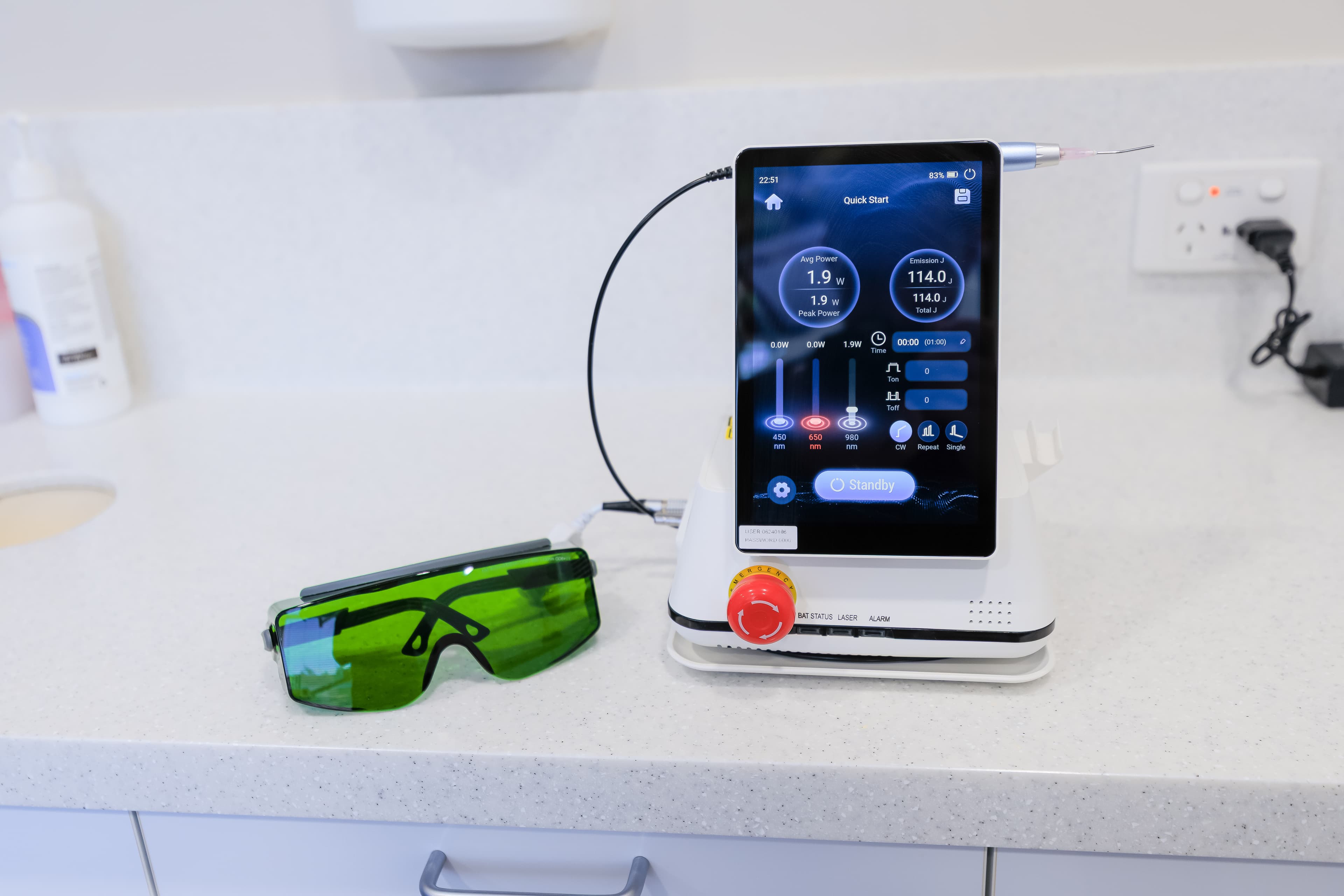
At Sienna Smiles, we have invested in TGA-cleared laser technology as part of our commitment to offering contemporary dental care in Hilbert. Laser is not a replacement for all traditional instruments — it is an additional tool used across general dentistry and specialist procedures when it offers a clinical advantage for your specific case.

Precision
Targets the treatment area with focused light energy, which may reduce impact on surrounding tissue.

Reduced Heat
Laser pulses are calibrated to minimise thermal build-up in surrounding tooth and gum tissue.

Less Noise
Laser procedures often involve less of the high-pitched sound associated with traditional drilling.

Reduced Bleeding
Soft tissue lasers can cauterise as they work, which typically reduces bleeding during gum procedures.
How laser compares to traditional instruments
Every dental procedure is different, and the choice between laser and traditional instruments depends on your specific clinical situation. Here is a general comparison of what patients may experience:
| Aspect | Traditional Dentistry | Laser Dentistry |
|---|---|---|
| Drilling | Mechanical drill is commonly required for most restorative procedures | May reduce or replace drilling in many procedures — assessed case by case |
| Anaesthetic | Local anaesthetic is commonly administered before most procedures | Some laser procedures may require less anaesthetic — your dentist will advise |
| Recovery Time | Recovery varies by procedure type and complexity | Healing times may be shorter for some patients — individual variation applies |
| Soft Tissue Precision | Standard precision with scalpel or electrosurgery instruments | High precision with minimal collateral tissue interaction in many cases |
| Post-Procedure Bleeding | Some bleeding is common with soft tissue procedures | Typically reduced due to the cauterising effect of the laser beam |
Individual experiences vary. The comparison above reflects general clinical observations and is not a guarantee of outcomes. Your dentist will advise on the most appropriate approach for your specific procedure.
Laser applications at Sienna Smiles
Dental lasers are versatile instruments used across several areas of dentistry. The following are procedures where your dentist may recommend laser as part of the treatment approach:
Gum Disease Treatment
Laser-assisted periodontal therapy may help remove diseased tissue and bacteria from gum pockets with reduced bleeding and discomfort compared to traditional curettage. Learn more about our gum disease treatment services.
Cavity Detection
Laser fluorescence technology can detect early signs of tooth decay that may not yet be visible on X-rays, supporting earlier intervention.
Soft Tissue Procedures
Frenectomy, crown lengthening and other soft tissue procedures may be performed using laser technology where clinically appropriate. Suitability, alternatives, expected recovery and possible risks will be discussed before treatment.
Teeth Whitening Enhancement
Laser energy can be used to activate whitening agents during in-chair teeth whitening procedures, potentially enhancing the treatment outcome.
Oral Lesion Management
Laser treatment may be considered for selected oral lesions after assessment. Your dentist will discuss whether treatment, monitoring or referral is appropriate.
Dental Hypersensitivity
Low-level laser therapy may help reduce tooth sensitivity by sealing exposed dentinal tubules on the tooth surface.
What to expect at your laser appointment
A laser treatment appointment at Sienna Smiles follows a straightforward process. Your dentist will explain each step before and during the procedure.
Consultation & Assessment
Your dentist examines the treatment area and determines whether laser is clinically appropriate for your procedure. The treatment plan — including whether laser will be used, the expected experience, and cost — is discussed before any work begins.
Preparation
Protective eyewear is provided for you and the dental team. Depending on the procedure, local anaesthetic may or may not be required — your dentist will advise. The laser is calibrated for the specific tissue type being treated.
Laser Treatment
The laser is applied to the treatment area in controlled pulses. Most patients describe the sensation as warmth or a light tapping. Treatment duration varies — many laser procedures are completed in less time than their traditional equivalents.
Recovery & Follow-Up
Post-treatment care instructions are provided. Many laser procedures involve less post-operative discomfort than traditional alternatives, though individual experiences vary. A follow-up appointment may be scheduled depending on the procedure.
Not every procedure needs laser.
That is the honest answer.
Laser dentistry is a valuable tool — but it is not universally applicable. Some procedures are better suited to traditional instruments, and some clinical situations require a combined approach. Your dentist will assess your specific needs and recommend laser only when it offers a genuine clinical advantage.
The best way to find out whether laser is appropriate for your situation is to discuss it at your next consultation. There is no obligation, no pressure, and no additional cost for the conversation.
Laser dentistry answered
Answers reviewed by Dr Singh, AHPRA DEN0001639626.
Curious about laser dentistry?
Let’s talk about it.
The best way to find out whether laser is right for your situation is a conversation. Book a consultation at Sienna Smiles — your dentist will explain the options, answer your questions, and never pressure you into a decision.